

 Sid
Sid
- What’s Covered, How Much, and How Long It Takes
- Step One: Figure Out Who to Actually Talk To
- Step Two: File Before You Leave the Airport
- US Domestic Carriers
- International Carriers that Fly to the US
- Step Three: The Waiting Game Has Its Own Rules
- Step Four: The Paperwork Takes Longer Than You’d Like
- Step Five: Following Up Without Losing Your Mind
- The Coverage Most People Forget They Have
- Our Take
We landed in Anchorage already three days behind schedule. It was about to get worse.
The plan was simple: fly from Fairbanks to Denver on Delta. Then Delta oversold the flight and asked for volunteers. We said yes. They put us on new flights through Anchorage instead, on Alaska and United. Our checked bags went ahead of us on the new route. That part was fine. Then we got to the United counter in Anchorage, and the agent had no record of our booking. We got bumped off the flight. Our bags, meanwhile, had already left without us.
Delta rebooked us again, three days later. This time we flew on separate flights, one of us to Denver and one to Chicago. Our bags were sitting in a city neither of us was flying to anymore. It’s exactly the kind of scenario that makes knowing your way around a Delta SkyMiles account worth the effort, since Delta ended up managing the whole mess even though they weren’t the airline that physically lost our bags.
More recently, a completely different trip tested the same process again. I was flying Qatar Airways business class from Delhi to Atlanta, originally routed through Doha. The flight got delayed, and Qatar rerouted me a different way entirely, through Doha and then London Heathrow, finishing the last leg on British Airways instead. New airline, new routing, same trip. My checked bag didn’t make it onto that final BA leg with me. It arrived a full day behind me, on the next BA227 into Atlanta. The very first message BA sent me had a missing baggage report number in it, so I could start tracking things right away.
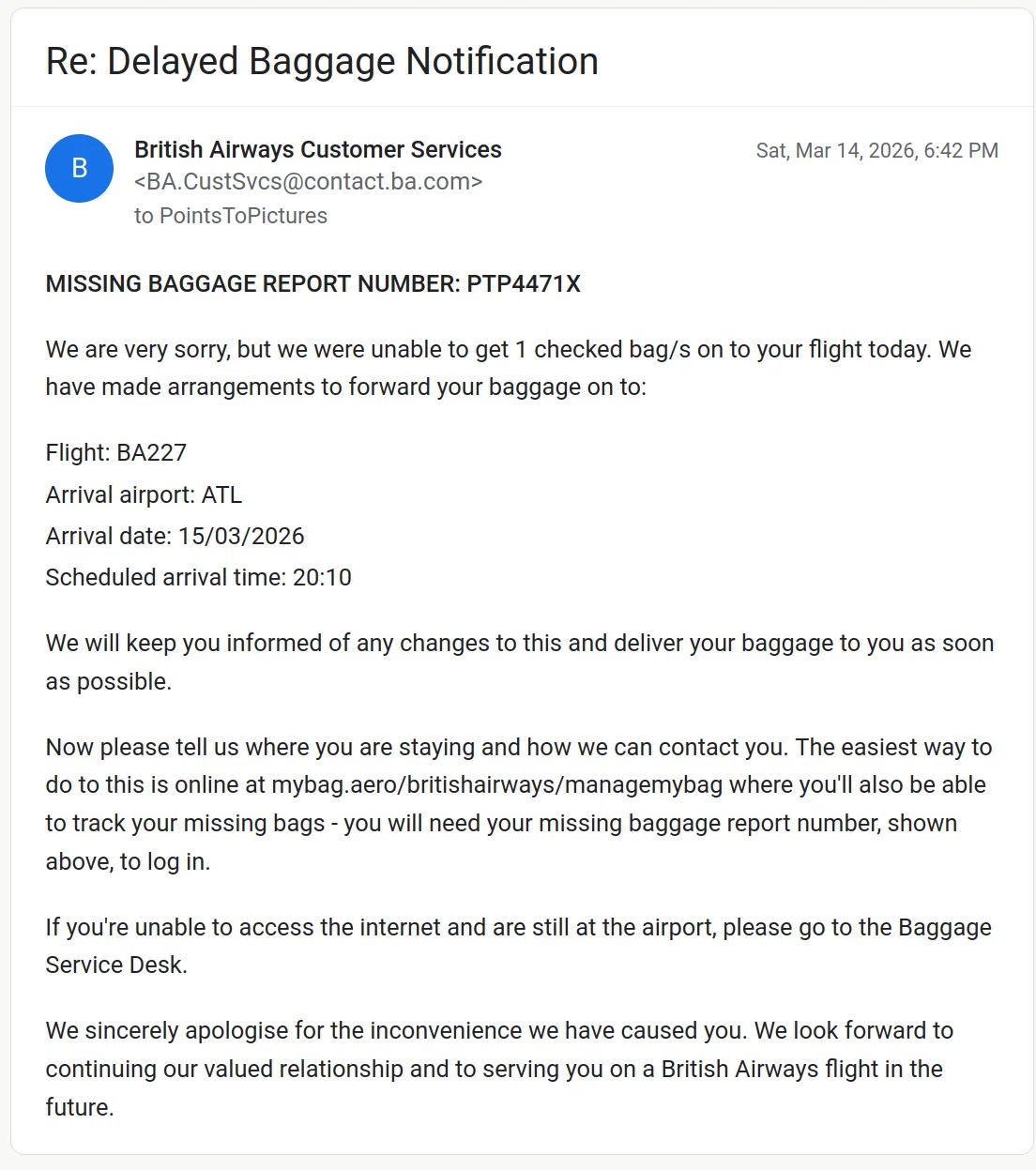
Two very different messes, two years and thousands of miles apart. Together, they cover almost everything you’ll actually run into if this happens to you. Here’s what happened next in both cases, step by step, and how each one got fixed. Hopefully this will help if it happens to you.
What’s Covered, How Much, and How Long It Takes
Start with what airlines will actually pay for. It’s less than most people think. They’ll cover basic things you need while your bag is missing: clothes, toiletries, and sometimes rides to go buy them. That’s it. No shopping sprees, no fancy replacements. Just enough to get by. Keep every receipt. You’ll need to list each item later, not just guess at a total.
Some things don’t count at all, no matter which airline you fly. Jewelry, cash, electronics, medicine, and anything you can’t replace should go in your carry-on, not your checked bag. Most airlines simply won’t pay for these if they’re lost. This isn’t the airline being cheap. It’s standard across the industry. Know this before you pack, not after your bag disappears.
There is a cap on how much you can get, and it depends on where you’re flying. Our Fairbanks-to-Denver trip was domestic, covered up to $4,700 per person, a limit raised from $3,800 in January 2025. My Delhi-to-Atlanta trip was international, so it fell under a different rule called the Montreal Convention, capped around $2,175. Both numbers cover everything together: your bag, what was inside it, and any money you spent while waiting. It’s not $4,700 plus your other expenses on top. Both amounts are based on what your stuff is worth now, not what you paid for it new. So take photos of anything expensive before you check your bag.
A bag isn’t officially “lost” the moment it doesn’t show up. Airlines call it delayed for the first five to fourteen days. Only after that do they call it lost and let you file for full value. Don’t panic on day one. But don’t wait past two weeks to push harder, either.
As for timing: nothing here moves fast. Filing the first report takes minutes. Getting paid takes weeks. Our Delta claim took about a month from mailing the form to a check showing up. The BA claim took even longer, since international claims add extra steps that domestic ones skip. Mine also landed near Christmas, which slowed things down further. Airlines handle these in order. Yours won’t jump the line.
Step One: Figure Out Who to Actually Talk To
Your first instinct will be to get angry at whoever’s counter you’re standing at. Don’t. Here’s the rule that matters: whoever flew the plane owns the bag, not whoever sold you the ticket. Check your boarding pass, right under the flight number, for the words “Operated by.” Can’t find it there? Your booking confirmation email has it too. Or search your flight number on a flight tracking website.
Our Anchorage mess broke that rule completely. United was the airline that actually separated us from our bags. But Delta was the one running the whole rebooking, twice. So that’s who we filed with. Nobody at Delta argued about who was technically at fault. When a mess involves more than one airline, file with whoever’s managing your trip right now. It’s one more reason it pays to understand how your Delta SkyMiles account and its rebooking tools actually work, since Delta ended up handling our claim even though they weren’t the airline that lost the bags.
The Delhi-to-Atlanta trip was easier to figure out, even with the rerouting through Doha and London. Only one airline flew the leg where the bag actually went missing. Qatar sold the ticket and flew the first legs, but BA flew the final segment into Atlanta, and that’s exactly where the bag got separated from me. So BA is who I called. When it’s one clean final leg that goes wrong, file with whoever actually flew that plane, no matter how many airlines came before it on the itinerary.
Step Two: File Before You Leave the Airport
This step isn’t optional. You can’t do it later from your hotel room. File a report while you’re still standing at baggage claim. How you do that depends on the airline, and the differences are bigger than you’d think, especially once you cross into international carriers.
US Domestic Carriers
Delta wants you at their Baggage Service Office in person, with no online option for that first report. American is the most self-service of the majors: scan the QR code at the carousel, enter your last name and confirmation code, and you’re filed without finding an agent, with a 13-character file ID issued on the spot. United goes furthest still, filing through their app, online chat, or by texting “BAGS” to 32050. Alaska and Southwest both still want an in-person report at the baggage desk, with online tracking available afterward.
| Airline | How to File | Reference Number | Baggage Line |
|---|---|---|---|
| Delta | In person only | File reference number | 800-325-8224 |
| American Airlines | QR code at carousel, app, or in person | 13-character file ID | 800-433-7300 |
| United | App, online chat, or text “BAGS” to 32050 | Case number via app | 800-221-6903 |
| Alaska | In person | Claim reference number | Confirm directly with Alaska |
| Southwest | In person | Claim reference number | 888-202-1024 |
International Carriers that Fly to the US
This is where my Delhi-to-Atlanta trip actually played out. When you’re flying on a partner ticket, like mine sold by Qatar but finished on British Airways, the airline that operated your final leg owns your baggage claim. That’s true across oneworld, Star Alliance, and SkyTeam alike. BA flew the segment where my bag went missing, so BA processed the claim, not Qatar, even though Qatar sold the original ticket.
Below are the world’s top-rated international airlines, filtered to only the ones that actually fly nonstop to or from the US. Most run on the same underlying baggage tracking system, called WorldTracer, so the process feels similar from one to the next even when the deadlines differ slightly.
You’ll file a Property Irregularity Report, at the airport or online, get a reference number, and use it to track your bag and later submit a written expenses claim. The near-universal pattern under the Montreal Convention: damage reported within 7 days of receiving your bag, a delay claim within 21 days, and a bag not found by day 21 gets treated as officially lost.
| Airline | How to File | Notes |
|---|---|---|
| Qatar Airways | In person (PIR), or online if you’ve left the airport | Final operating carrier handles the claim on alliance tickets, confirmed directly from my own Delhi-Atlanta trip |
| Singapore Airlines | Online form (about 10 minutes) or at the Lost & Found office | Online reporting only valid if Singapore operated your final flight; 7-day window if reporting after leaving the airport |
| Cathay Pacific | In person, Baggage Service Office | Standard PIR and WorldTracer process |
| Emirates | In person or online | 7 days for damage, 21 days for delay |
| ANA | In person, Baggage Service Office | Standard PIR and WorldTracer process; confirm current online options directly |
| Turkish Airlines | In person or online (“Report Delayed Baggage”) | 5-day initial search window, up to 21 days before declared lost |
| Korean Air | In person (PIR required before leaving airport) | Online claim form won’t accept a submission without the PIR reference number |
| Air France | Online or at the airport, within 48 hours | 21-day delay window; distinct process from KLM despite joint ownership |
| Japan Airlines | In person, Baggage Service Office | Standard PIR and WorldTracer process; confirm current online options directly |
| Hainan Airlines | In person, Baggage Service Office | Currently operates 13 nonstop US-China routes; not part of a major alliance, so points redemptions are limited |
| Swiss International | In person or online, similar to Lufthansa | Part of the Lufthansa Group; processes track closely with Lufthansa’s |
| EVA Air | In person, Baggage Service Office | Standard PIR and WorldTracer process; confirm current online options directly |
| British Airways | In person, or online after departure | 8-day reporting window; issued the report number for my claim in their first message |
| Qantas | In person, Baggage Service Office | Standard PIR and WorldTracer process; confirm current online options directly |
| Lufthansa | In person or online | 7-day damage window; online refund request form for reimbursement |
| Virgin Atlantic | In person, Baggage Service Office | Standard PIR and WorldTracer process; confirm current online options directly |
| STARLUX Airlines | In person, Baggage Service Office | Newer carrier serving LAX, SFO, and Ontario, CA; confirm current process directly |
| Air Canada | In person, Baggage Service Office | Extensive US route network despite being Canada’s flag carrier; standard PIR process |
| Iberia | In person, Baggage Service Office | Same corporate group as British Airways; processes track closely |
| KLM | Online within 48 hours, or at the airport | 21-day delay window; AirTag location sharing supported |
| Air New Zealand | In person, Baggage Service Office | Standard PIR and WorldTracer process; confirm current online options directly |
| Finnair | In person, Baggage Service Office | Standard PIR and WorldTracer process; confirm current online options directly |
Whatever airline and method you use, you’ll get a reference number. Write it down right away, or take a screenshot. Don’t trust someone telling you “it’ll probably turn up.” If you have an AirTag or similar tracker in the bag, several major carriers, including Delta, American, and KLM, let you share its location with them directly. This can speed things up a lot, especially on an international itinerary where your bag might be sitting in a different country entirely.
Step Three: The Waiting Game Has Its Own Rules
Once you’ve filed, you wait. Different airlines promise different things after different amounts of time. Alaska has a 20-minute guarantee: if your bag isn’t at the carousel within 20 minutes of your flight reaching the gate, you get 2,500 Atmos Rewards points or a $25 discount code. But you have to ask for it within 2 hours of landing. It’s a nice perk if you’re already earning Atmos Rewards points through Alaska. Delta has a similar guarantee at some airports. Southwest works on a longer clock. They refund your bag fee once a domestic bag is missing for 12 hours, or 15 hours on an international flight.
None of these get you the full payout right away. They’re smaller, faster perks, points, a discount, a fee refund, while the bigger claim moves through separately. Don’t confuse the two.
Our Delta bags were missing for three full days. My bag out of Delhi showed up just one day behind me, on that next BA227 flight into Atlanta. In both cases, we bought clothes and toiletries. With Delta, we also paid for rides to go get them. We kept every receipt, because that’s exactly what comes next.
Step Four: The Paperwork Takes Longer Than You’d Like
This is where most people get surprised. Filing a missing bag report is not the same as filing a claim for money. Airlines want the claim submitted separately, in writing, with your receipts attached.
Delta mailed us a form. We filled it out and listed every cost with receipts: $62 for clothes for one of us, $67.88 for the other, $14.10 in toiletries, $32.75 for local rides, $176.73 total. We mailed it back. Weeks went by. A claims manager eventually called, went over the numbers, and paid the full amount by check.
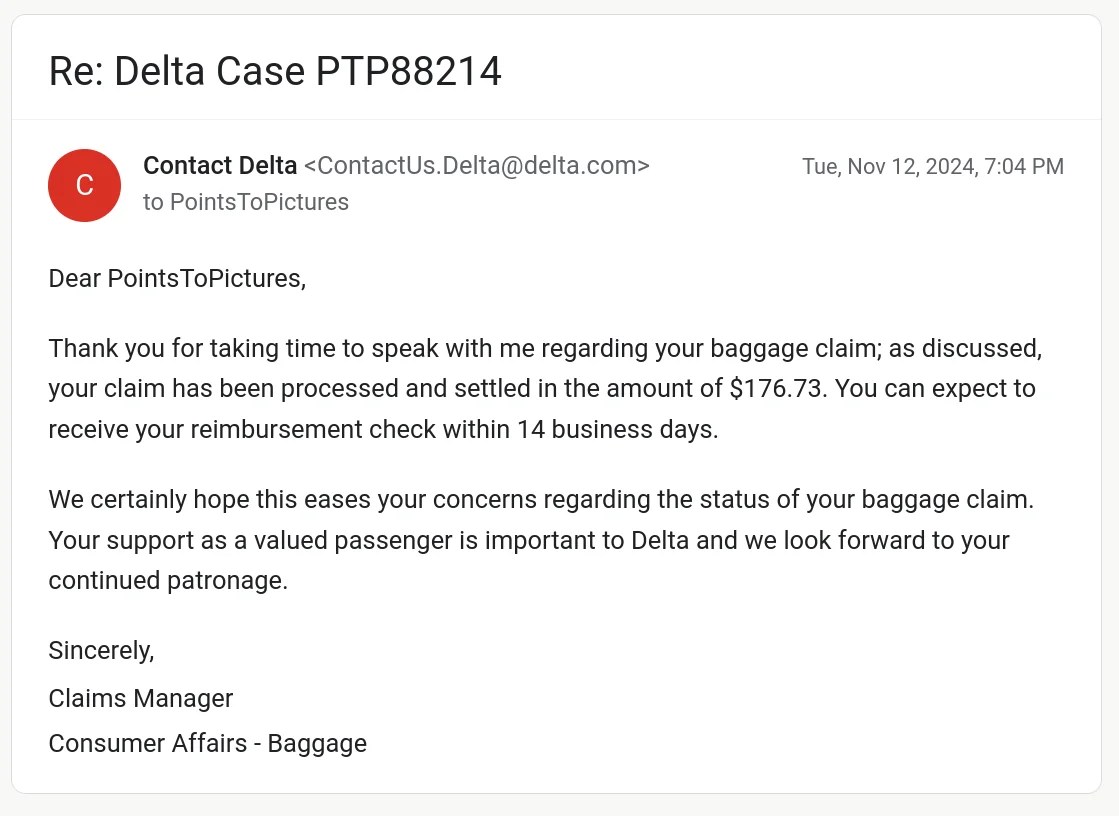
BA’s process added steps Delta never asked for. Before they’d even open my case, BA wanted a copy of my passport, citing privacy law rules. Once my bag was confirmed delivered, they moved toward paying me back.
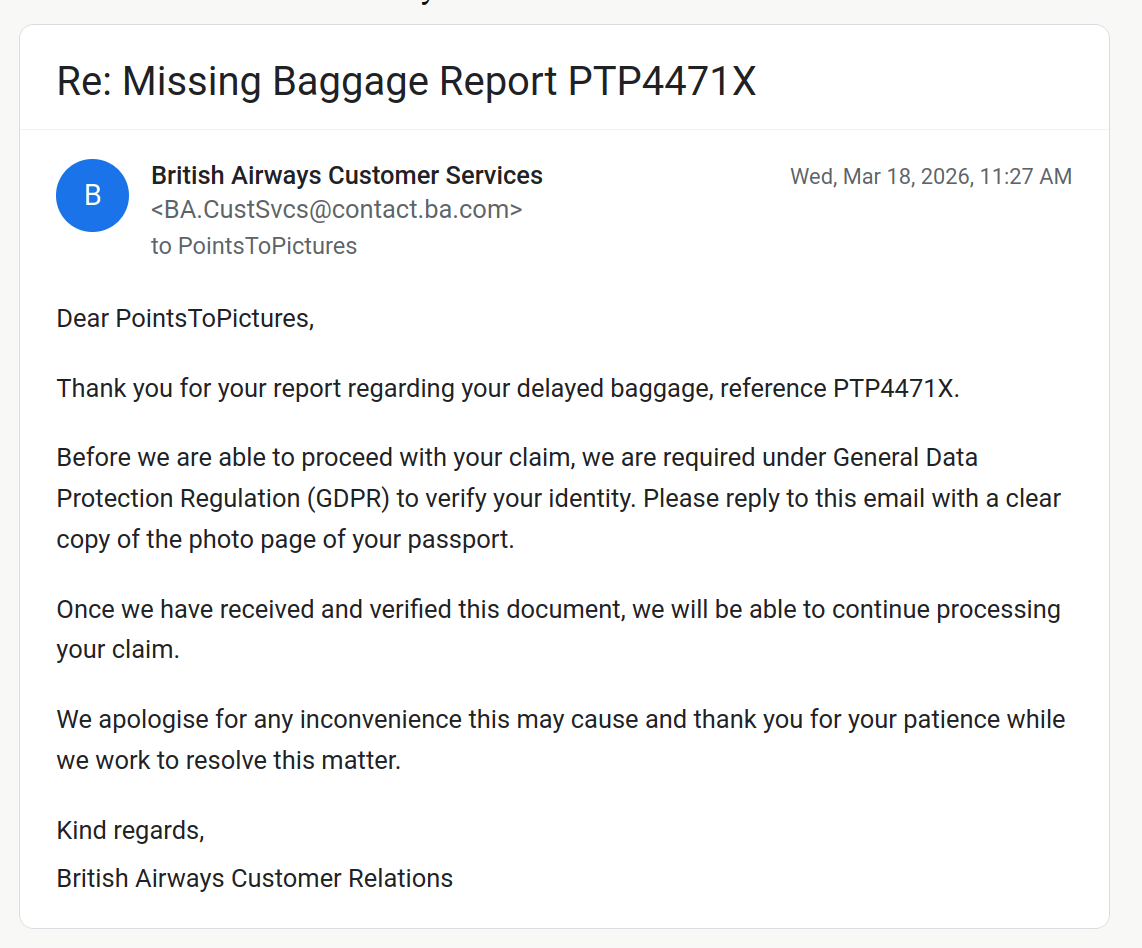
But that came with a snag too: they needed my bank details, then separately asked for my U.S. home address, since the bank account’s country has to match where you live on file. A small detail, but it held things up for a few days until I sent it in. None of it was unfair. It just took longer than Delta’s process did.
Step Five: Following Up Without Losing Your Mind
My BA claim landed right around Christmas. The airline told me upfront that payment would wait until January 2, then take three to five more business days to show up. Nothing was broken. The claim was just stuck behind a holiday backlog. The Delta claim didn’t hit a holiday, but it still took about a month between mailing the form and the check arriving.
Here’s the pattern worth remembering: these things move in weeks, not days. A request for more documents means your claim is moving forward, not stalling. My BA payout came to $130.25. Delta’s came to the full $176.73. Neither airline argued about the amount once the paperwork was done.
The Coverage Most People Forget They Have
Federal limits are the floor, not the ceiling. A lot of premium travel cards include baggage delay insurance on top of what the airline pays, not instead of it. Some go well past the $4,700 domestic or $2,175 international caps.
If either of our claims had gone over those limits, this is exactly where we’d have turned next. Check your card’s list of benefits before you assume the airline’s number is the final word. Make it part of your yearly benefits check, since it’s easy to forget this perk exists until the day you actually need it.
Our Take
File with whoever’s running your trip right now, not whoever you’re angriest at. Get a reference number before you leave the airport. Keep every receipt like it’s evidence, because it is.
Expect a written claim over instant cash, and extra verification if you’re flying internationally, especially around the holidays.
A three-airline disaster and an international reroute across three airports both ended the same way: paid in full, just not fast. The process works if you follow it in order and don’t quit halfway through the paperwork.
Frequently Asked Questions
For domestic flights in the US, airlines can reimburse up to $4,700 per person (a limit raised from $3,800 in January 2025). For international flights, the Montreal Convention caps compensation at around $2,175. Both limits cover your bag, its contents, and any expenses you incurred while waiting u2014 not each separately.
Airlines will typically cover necessities like clothing, toiletries, and sometimes transportation to purchase them. They won't pay for luxury items or non-essential replacements. Save every receipt, since you'll need to itemize purchases rather than estimate a total.
No u2014 most airlines will not reimburse for electronics, jewelry, cash, or medication lost in checked bags, regardless of the airline or route. These items should always travel in your carry-on, not your checked luggage.
Airlines typically classify a bag as delayed for the first five to fourteen days after it goes missing. Only after that window do they reclassify it as lost and allow you to file a full-value claim. Don't panic immediately, but do push harder if two weeks have passed without resolution.
The process is slow u2014 filing the initial report is quick, but getting paid takes weeks. A domestic Delta claim described in this post took about a month from submitting paperwork to receiving a check. An international British Airways claim took even longer, since international claims involve additional steps beyond what domestic ones require.


